As I write these words, an estimated three million people are gathered in Rome to observe the funeral services of Pope John Paul II who died on April 3. The figure is impressive, and this is just the people who have come to Rome for the event, not those already there. News commentators marvel at this tremendous “outpouring of humanity.” On the day of the event, and for long afterwards, we can expect to be barraged by close-up images of people in prayer, bereaved, devout, reverent, their faces and indeed their entire bodies seized by deep emotion.
What are they feeling? What do they believe? Why are they there?
The dynamic of faith is extremely difficult to grasp, because faith seems to have an almost magical ability to grant power to those who give power to it. This dynamic has been called the placebo effect. It works with many things, from medicines to mantras. The efficacy of a placebo inheres in a feedback loop: it gives power to those who give it power. For instance, taking the Host at Mass gives power to those who give it power. To those who give it no power, it is ineffectual.
However, the placebo effect does not consist just in this two-way exchange. There is a trick involved: the returning power of the placebo (be it an object, such as the Host, or an idea, such as grace) appears to be independent of the power granted to it in the first place. The feedback is effective, and tends to quell any doubting or critical observation, because the way it works tends to conceal the true nature of this exchange: giving away power to get power. Those who receive the Host in Catholic mass, believing in the independent power of the Host, get back far more through their faith than they give. Or so it appears.
But the operation of faith here is deceiving. We are not yet at the core dynamic of the placebo effect. There is another layer of dissimulation at work. The placebo effect makes it appear as if believers get more than they give (first level of dissimilation), but in reality believers may be giving more than they get (the second, deeper level of dissimilation). The placebo effect is wonderful, and really works, otherwise there would not be so many deeply religious people in the world, but what goes without notice is the investment that must be made to get a convincing return.
Excerpts from
The Tyranny of Faith: Reflections on the Death of a Patriarch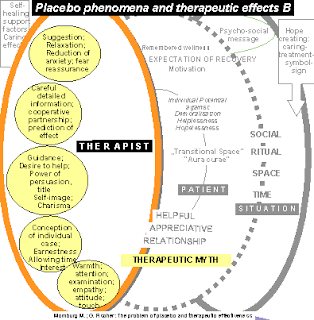


 Refraction: "The bending of a wave, such as a light or sound wave, as it passes from one medium to another medium of different density. The change in the angle of propagation depends on the difference between the index of refraction of the original medium and the medium entered by the wave, as well as on the frequency of the wave." (per the American Heritage Science Dictionary).
 Noise-barrier design: 1970's engineering studies focused extensively on refraction as a method of designing highways' borders with their environment.


